
The difference between data errors and process errors — and why the latter is more dangerous.
Most operators worry about the wrong thing.
They fear the data error —
a wrong address, a mixed file, a mismatched record.
The “what if the bureau got it wrong?” scenario.
But that’s not where most operational exposure usually shows up.
The real danger is the process error.
And most of this risk is hiding just below the surface.
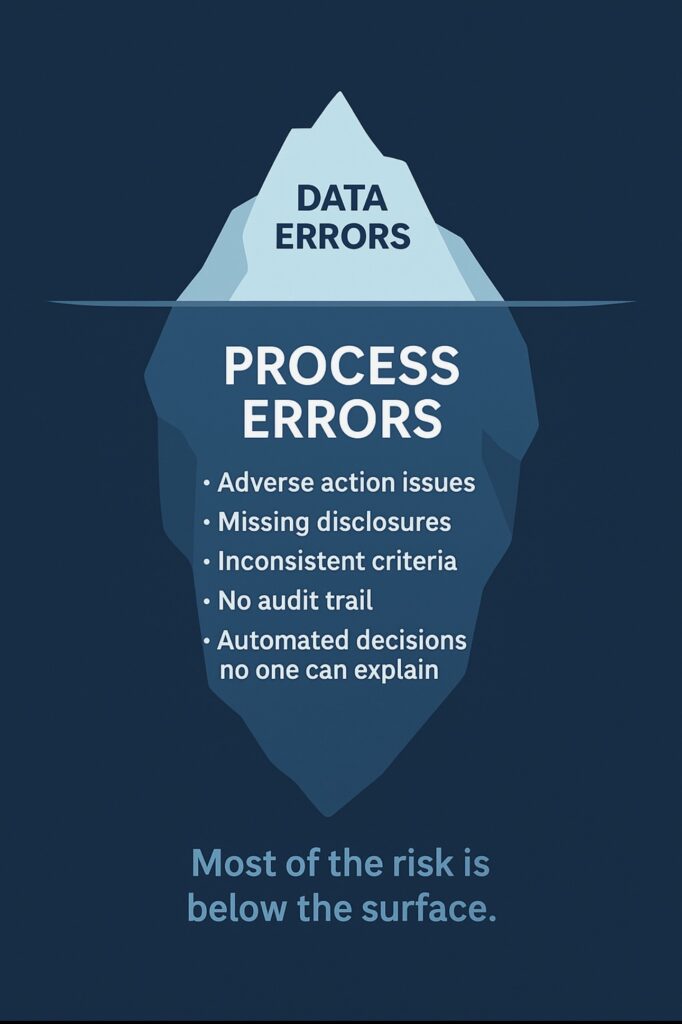
1. The Myth: “FCRA risk = bad data.”
It’s common in rental housing to equate FCRA risk with inaccurate reports.
It feels intuitive.
If a screening report has something incorrect, that must be the source of risk… right?
Not quite.
Data errors are often:
- Traceable
- Subject to a defined dispute and reinvestigation process
- Correctable by the consumer reporting agency (CRA)
- Documented and time-bound by statute
In other words: they can create real harm, but there is at least a clear path for correction and remediation.
And in many cases, there is a documented paper trail showing what happened.
2. The Reality: FCRA risk actually comes from process design.
Most of the real exposure for operators comes from what they do (or fail to do) with the data.
Process gaps show up in places like:
- Missing or outdated FCRA disclosures and authorizations
- Denials or conditional offers without proper adverse action notices
- Inconsistent use of criteria across sites or portfolios
- Staff applying judgment differently without documented standards
- Decisions made without clear, written criteria
- Systems that automate steps the operator can’t later explain or reconstruct
Those aren’t “bad data” problems.
They’re design problems.
And they’re much harder to defend after the fact.
3. Why process errors are more dangerous
Data can be corrected.
But once a required notice wasn’t sent, criteria weren’t followed, or a record was used in a way you can’t justify, the violation (or fair housing exposure) has already occurred.
You can remediate going forward.
You can’t rewrite what already happened.
That’s where most operators struggle when something is challenged.
Because without defensibility, key questions go unanswered:
- What criteria were used?
- Who made the decision?
- What information was actually relied on?
- Was the decision consistent with others in similar situations?
- How was the applicant informed of their rights?
If you can’t answer those cleanly, your biggest problem isn’t the report.
It’s your process.
4. The overlooked truth: automation doesn’t eliminate process risk
A lot of teams assume automation = compliance.
In reality, automation mostly makes whatever process you already have:
- Faster
- More scalable
- Harder to explain if you don’t understand it
If the workflow wasn’t defensible before you automated it, it won’t magically become defensible after.
Speed amplifies gaps.
It doesn’t close them.
We’re already seeing this with algorithmic scores and AI-driven tenant risk models. When decision logic is opaque or overly broad, it introduces both FCRA and fair housing risk — even if the data feeds are technically “accurate.”
5. What to focus on instead
The question shouldn’t just be:
“Is the data right?”
It should be:
“Can we show what we did with the data — and why — in a way that holds up?”
The strongest operators build around:
- Clear, written screening criteria that tie to legitimate business interests
- Standard, accurate disclosures and authorizations
- Consistent adverse action workflows (including conditional approvals)
- Documented decision trails that show what was considered
- Human-in-the-loop review for nuanced or borderline cases
- Logging and audit trails that capture actions, not just scores
That’s what creates defensibility.
Not “perfect” data.
Not more automation.
Not a longer feature list.
Process.
Final thought
Data errors can bruise you.
Process errors can bury you.
If you want to really reduce FCRA and fair housing risk, strengthen the part no one sees:
The decisions, the documentation, and the design behind your workflow.
That’s where compliance actually lives.
That’s where defensibility is built.
And that’s where too many operators are still flying blind.
Standard disclaimer: This is general educational information, not legal advice. Operators should consult their own counsel about specific obligations and policies.